
Python
Criminology and sociolegal statistics: the Python package binds the same
compiled kernels as the R package crimlab (../src), with the same
function names, the same argument names and the same results. Every
number in the parity tests (tests/data/ref.json, written by
dev/pyref.R from the R package) is bit-for-bit what R returns.
The package imports nothing outside Python’s standard library: no runtime dependencies, no optional ones. Results are dicts of its own that print as R prints them, export themselves as CSV or JSON, and (tables) sort, filter and join; the two plots draw themselves as SVG, by the same compiled code every binding can use.
Install
Section titled “Install”From a clone of the repository (a C++17 compiler is needed):
pip install ./pyThe CI workflow (.github/workflows/py.yml) also builds wheels (one per
platform, stable ABI, Python 3.10 and later) and an sdist as workflow
artifacts. The package is not published on PyPI.
Examples
Section titled “Examples”Disparity:
>>> from crimlab import vodtst, dspbm>>> vodtst(day={"white": 600, "black": 400}, night={"white": 700, "black": 300})  group   ref shday shnight    ratio sign1 white  TRUE   0.6     0.7 1.000000   -12 black FALSE   0.4     0.3 1.555556    1
>>> dspbm(pop={"a": 9000, "b": 1000}, contact={"a": 900, "b": 300},...       force={"a": 9, "b": 6})["rd"][1.0, 6.0]
Forensics:
>>> from crimlab import gtmp, cllrmin, kinidx>>> round(gtmp(p={"D3": 0.1, "vWA": 0.2}, q=[0.3, None], hom=[False, True],... theta=0.03)["log10lr"], 4)2.3068>>> kinidx({"D3": [12, 14]}, {"D3": [12, 14]}, {"D3": [0.1, 0.2]}, rel="sibling")["locus"] locus idx1 D3 8.375>>> cllrmin([50, 200, 8], [0.01, 0.2, 1.5]) cllr min cal0.3008346 0.0000000 0.3008346Policing:
>>> from crimlab import clrsmp, expbnd>>> clrsmp(clra={"minor": 90, "serious": 20}, reca=[100, 50],... clrb=[19, 60], recb=[20, 140])["total"]["simpson"]2.0>>> expbnd(y={"white": 100, "black": 300}, m=[1000, 1000], gamma=1.5)["sign"][0, 1]Corrections:
>>> from crimlab import incap, sntbnd>>> incap(lam={"low": 2, "high": 10}, q=0.1, s=1, share=[0.8, 0.2])["group"]['low', 'high', 'all']>>> sntbnd([1, 0, 1, 1, 0, 0], ["a", "a", "b", "b", "b", "a"], treat="b")["term"]['a', 'b', 'effect']Proofs and the self-test:
>>> from crimlab import proof, selftest>>> proof("orrisk")["theorem"][0]'Crimlab.RelRisk.or_eq_rr_mul'>>> selftest()["nfail"]0Results
Section titled “Results”| R | Python |
|---|---|
| data frame | Table: a dict of columns (lists), in R’s column order |
| named numeric vector | Vector: a dict of floats |
| list | Record: a dict of results |
NA |
None |
NaN, Inf |
float("nan"), float("inf") |
Each is still the dict it was (r["ratio"], dict(r), r.items() work
as for any dict) and prints as R prints it: a table with row numbers
first, numbers to 7 significant digits, a long table cut to its first 10
and last 5 rows with the row count; a vector with names above values; a
record part by part under $name. A Table also has:
shape,rows()(a list of dicts),row(i);csv(): RFC 4180 text, CRLF line ends, numbers in full (the shortest text that reads back to the same double), None as an empty field, NaN and the infinities asNaN,Inf,-Inf, bools asTRUE,FALSE;json()(also onVectorandRecord): None isnull; NaN and the infinities, which JSON has no numbers for, are the strings"NaN","Inf"and"-Inf";sort(by, desc=False): by a column or a list of them; stable;descone bool or one per column; None and NaN last either way; text by code point, numbers (bools as 0 and 1) numerically; text and numbers in one column is an error;filter(f=None, **conds):col=(op, value)with op one of==,!=,<,<=,>,>=,in(value a list),col=valuefor==, and f a function of a row (a dict); conditions combine with and; a missing value never passes; an unknown column or operator is an error;join(other, on, how="inner"): with another table or any dict of equal-length columns, on one key column or a list;howis inner, left, right or full. Keys match by exact equality, text with text, numbers with numbers (1 with 1.0), bools with bools; a missing key (None or NaN) matches nothing. Rows come in this table’s order, each with its matches in the other’s order, then the other’s unmatched rows (right, full); a key on n rows here and m there gives n * m rows; unmatched cells are None. Columns: the keys once, then this table’s, then the other’s; a name in both that is not a key gets.xhere and.ythere. Hash-based, linear time.
Each returns a new table and leaves the first unchanged. There is no
select: a dict comprehension is one, Table({k: t[k] for k in cols}).
>>> from crimlab import expbnd>>> r = expbnd(y={"a": 100, "b": 300, "c": 7}, m={"a": 1000, "b": 1000, "c": 70},... gamma=1.5)>>> r.filter(ratio=(">", 1)).sort("rate", desc=True) group ref rate lo hi ratio rlo rhi sign1 b FALSE 0.3 0.2 0.45 3 1.333333 6.75 1>>> r.csv().splitlines()[1]'a,TRUE,0.1,0.06666666666666667,0.15000000000000002,1.0,0.4444444444444444,2.25,0'tipplt() and eceplt() return the data of the plot. Their result has
svg(), which returns the plot as a standalone SVG document: axes with
tick labels, the curves, a legend, a title and axis labels; text as text
(a system sans-serif stack) and colours that read on light and dark
backgrounds; the same bytes on every machine. A method, not a file
argument: the result stays data first, the picture is asked for when it is
wanted, and where it goes (a file, a web page, a notebook) is the
caller’s choice, with no paths or file handling in the package.
>>> from crimlab import tipplt>>> svg = tipplt([50, 200, 8, 0.5], [0.01, 0.2, 1.5, 0.001]).svg()>>> svg.splitlines()[1][:40]'<svg xmlns="http://www.w3.org/2000/svg" '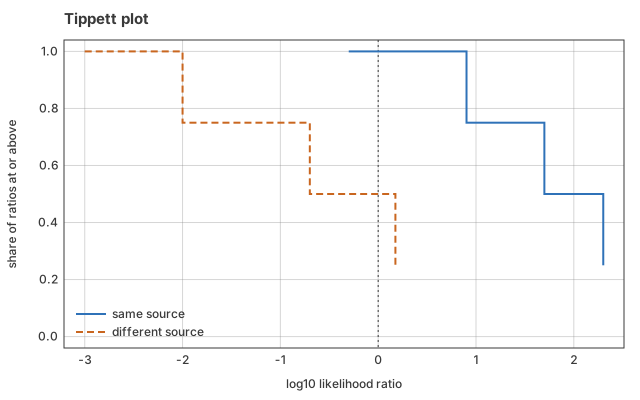
Optional packages (never required)
Section titled “Optional packages (never required)”NumPy, pandas and matplotlib are never imported by crimlab, but work with it through their own generic protocols:
import numpy, pandasvodtst(numpy.array([600.0, 400.0]), [700, 300]) # an array as input, zero copypandas.DataFrame(vodtst({"w": 600, "b": 400}, {"w": 700, "b": 300})) # a result as a frameplt.step(t["same"]["log10lr"], t["same"]["share"], where="post") # t = tipplt(...)A pandas Series is read as its values, by position; for its index as group
names, pass dict(s). A DataFrame is a table of rows by
df.to_dict("index") (a mapping of mappings).
Inputs
Section titled “Inputs”Numbers are one number (Python has no vector of one), a sequence
(list, tuple, array.array, memoryview, range) or an array: any
object with __array_interface__ (a NumPy array, for one). An array of
contiguous float64 is read in place, without a copy; other numeric types
(float32, any integer type), strided arrays and object arrays are
converted; an array whose byte order is not the machine’s is read as a
sequence when it is one. A 2-D array with one row or one column is the
vector it holds; an array with more than one dimension above 1 is refused
with R’s message (“must be a vector, not a matrix …”). A nested list is
not flattened: it is refused as not numbers.
Not numbers (TypeError): text, bytes, bools (as in R, a logical is not a number), dates, complex numbers, dicts and sets where numbers are expected, iterators and generators, nested sequences.
Missing values are None and float("nan"), both read as R’s NA.
Where R refuses NA they are refused with R’s message (ValueError); where
R accepts it (q at a homozygous locus of gtmp(), y for a detained
defendant in sellab()), so does Python.
Logical arguments (hom, rel, rule) take bools (any type named
bool, so NumPy’s too), one or a sequence or a bool array; numbers are
refused as in R.
Labels (the sentences z of sntbnd(), alleles) are text, numbers or
bools, written as R’s as.character() writes them: 2.0 is "2",
0.1 + 0.2 is "0.3", 1e5 is "1e+05", True is "TRUE".
Named values are a mapping (dict) from name to value, or, where a name
repeats (which a dict cannot hold), a list of (name, value) tuples:
[("a", 1), ("a", 2)].
Tables (count of dyadrt(), genotypes, freq, the one-table form of
vodtst()) are a sequence of rows, a 2-D array, or a mapping from row name
to row; a row is a sequence, or a mapping from column name to value (every
row naming the same columns), so a table with row and column names is a
mapping of mappings: {"a": {"a": 640, "b": 160}, "b": {"a": 100, "b": 40}}.
Row names that repeat: a list of (row name, row) tuples. Genotypes have
two columns, one row per locus; two values are one locus.
Names are the identity of a group, under the rule of the R package
(src/bind.cpp, align()). An argument is named when it is a mapping
(dict) or a list of (name, value) tuples; a table names its rows when it
is a mapping (see Inputs).
- All the arguments of a call that hold one value per group (or per unit,
per locus, per arm) named, with the same names: each is matched to the
first by name, in any order.
vodtst({"a": 6, "b": 4}, {"b": 5, "a": 5})pairsawitha. - All named, with different names: an error that lists them,
vodtst: `night` must name the same groups as `day`; missing: b; extra: c. - Some named, some not: positions, as given. Only names protect against a mismatch.
- A name given twice in a per-group argument is an error
(
vodtst: `day` names a group twice: a.); in a per-unit argument (outtst(),lrpost(),rtmhs(),sellab(),sntbnd()) it leaves positions in use. - Only arguments of the length of the first take part: one value to be recycled keeps its place.
- The groups are named by the first argument that names them, else
"1","2", …; the output keeps the order of the first argument.refis a position from 1 in that order when it is a number, a group name otherwise, and is never chosen by sorting;vodtst(),dspbm()andexpbnd()mark it in theirrefcolumn. vodtst(day=table): withnightleft out,dayis one table whose two columns are nameddayandnight: a dict of the two columns, or a mapping from group to{"day": ..., "night": ...}.dyadrt(): acountthat names its rows and its columns (a mapping of mappings) has its columns matched to its rows by name, and both topopwhenpopis named.- Genotype tables and
freqthat all name their loci are matched by locus to the first. hzdsel():surhandsurlboth namedcontrolandtreated, in either order, are read by name; otherwise the first value is the control arm.
Errors
Section titled “Errors”Errors are exceptions whose message is R’s, word for word, starting with
the function’s name: ValueError for a value outside what the function
takes (missing, not finite, out of range, wrong length), TypeError for an
argument of the wrong kind. A failed allocation is a MemoryError.
Differences from R
Section titled “Differences from R”orrisk()’s first argument isor, as in R, butoris a Python keyword: give it by position, or asorrisk(**{"or": 3}, rate=0.4, share=0.5).- Results are dicts of the package’s own classes (see Results). An
unnamed result of one number is a float for
cllr();lrpost()always returns a list;lrcal()returns aRecordof two lists. - R’s forms of a named vector (a 1-d table, a list of single numbers, a
one-row data frame) are a dict, or a list of
(name, value)tuples, in Python; a matrix with row and column names is a mapping of mappings. ref: a bool or None is refused with a TypeError; a number is always a position, so a group named by a number cannot be chosen by name. R reads a factorrefby its label; Python has no one-value categorical.tipplt()andeceplt()return the plotted data and draw nothing; the picture issvg()on the result (R draws on the current device with base graphics and returns the data invisibly).- None and NaN are both R’s
NAon input. On output R’sNAis None andNaNis NaN. - A nested list where a vector is expected is refused as not numbers
(TypeError); R’s message for a matrix is given for arrays with more
than one dimension above 1. For the allele names of
mixlr()a 2-D array is refused as not names ofp. treatinsntbnd()must be one label; a list, even of one label, is refused (R accepts a vector of length 1). The default (True for bools, 1 for numbers 0 and 1) follows R.- A one-row genotype table is named
"1"unless it is named (mapping key); R names a one-row matrix by its only column name when it has column names but no row names. Column names that repeat cannot be given as a mapping; such a table is given by position. proof():Nonemeans every function (R’sNULL); R’sNAhas no Python spelling, and[None]is refused.proof()lists the network functions too, which are not bound in Python yet.- When several arguments are wrong at once the first error reported may differ: names and labels are checked in Python before the numbers are checked in the compiled module.
- R conditions carry a call; Python exceptions have none.
selftest()is exported (R runs the self-test through an internal.Call).- R-only kinds of input have no counterpart:
"bytes"-encoded strings, classed numbers with units, labelled vectors (R refuses them with a message of its own), factors, environments. - Tables print with R’s layout but are not R’s printing in every detail (column widths, the choice between fixed and scientific per column).
- Not bound yet: the network functions
ntdeg,ntbtw,ntcls,ntevc,ntcore,ntcmp,ntlvn,ntmod,ntbrk,ntchgandcoofg. Their kernels are compiled into the module and run inselftest().
Development
Section titled “Development”From the repository root:
pip install ./py pytestcd py/tests && python -m pytest # pytest only, nothing elsepython -m pytest opt.py # NumPy, pandas, matplotlib, if installedpython -m pytest --doctest-modules --pyargs crimlabRscript dev/pyref.R LIB # regenerate tests/data/ref.json from Rsetup.py copies the kernel sources (../src/*.cpp and *.h that do not
include R), the version (../DESCRIPTION), the proof table
(../src/bind.cpp), the Lean files (../inst/lean) and the licence into
py/ before every build; those copies are build output and are not
committed. An sdist carries them and builds on its own.
Adding a function: its entry point in ext/clab.cpp (one function and one
line in the method table), its wrapper with a docstring in crimlab/, its
name in __all__ and _clab.pyi, and its cases in dev/pyref.R.
A documentation site is left to the maintainer; the docstrings follow the
numpydoc layout, so Sphinx with numpydoc or napoleon can render them.